

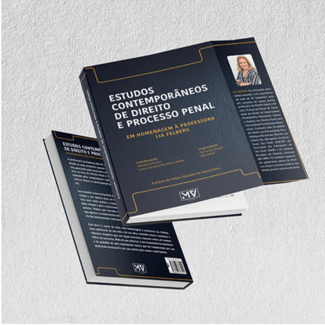
Contemporary Studies in Criminal Law and Criminal Procedure
In honour of Professor Lia Felberg
Asset Seizure in the Case Law of the TRF-4: The Presumption of Periculum in Mora as an Expression of Symbolic Criminal Justice in the Face of Economic and Financial Crime
Marco Aurélio Pinto Florêncio Filho & Carlos Gilberto Martins JúniorThe article examines whether the application of asset seizure in criminal proceedings, without the requirement to demonstrate periculum in mora — as established by the case law of the Federal Regional Court of the 4th Region (TRF-4) — is compatible with the constitutional procedural system. The research concludes that such practice infringes upon the presumption of innocence and due process of law, anticipating the effects of a criminal conviction and directly reflecting the symbolic criminal policy of asset recovery in combating economic and financial crime.
Editors: Fernanda Gurgel · Orly Kibrit
Coordinators: Renata da Rocha · Carlos Eduardo Nicoletti Camillo
Foreword: Felipe Chiarello de Souza Pinto
ISBN: 978-65-983734-2-9
Pages: 387
Publisher: MV Editora

Criminal Collaboration Agreement Contaminated By Nullity and its Effects to the Accused: is the Prohibition of Challenging the Criminal Collaboration Agreement By the Accused Constitucional
Is the prohibition on the accused informant's right to challenge the plea agreement constitutional?
The main purpose of this article is to verify whether the impossibility to contest the criminal collaboration, by the accused, in the same way of Superior Court of Justice and Federal Supreme Court’s main jurisprudence, is compatible with the constitutional procedural system, as well as examine whether it regards the adversarial principle, full defense and the due process of law.
Keywords: Plea Agreement · Nullity · Accused Informant · Criminal Procedural Law
Journal: REDUnB, Brasília
Volume / Issue: vol. 21, no. 1 · pp. 84–110
Year: 2024
Institution: UnB

The Operation of Militias and Its Impacts on Rio de Janeiro State’s Public Safety: A Critical Analysis About the Current Model Of Security According to Citizenship
A critical analysis of the current security model through the lens of citizenship
The article investigates whether the concept of public security as the maintenance of public order, enshrined in the Brazilian Federal Constitution of 1988, contributed to the emergence and expansion of militias in the state of Rio de Janeiro, as well as whether the adoption of a citizen security model could represent an effective alternative in combating these groups.
Keywords: Militia · Public Security · Police · Citizen Security
Journal: Revista Avant, Florianópolis
Volume / Issue: vol. 6, no. 2 · pp. 74–97
Year: 2022
Institution: UFSC